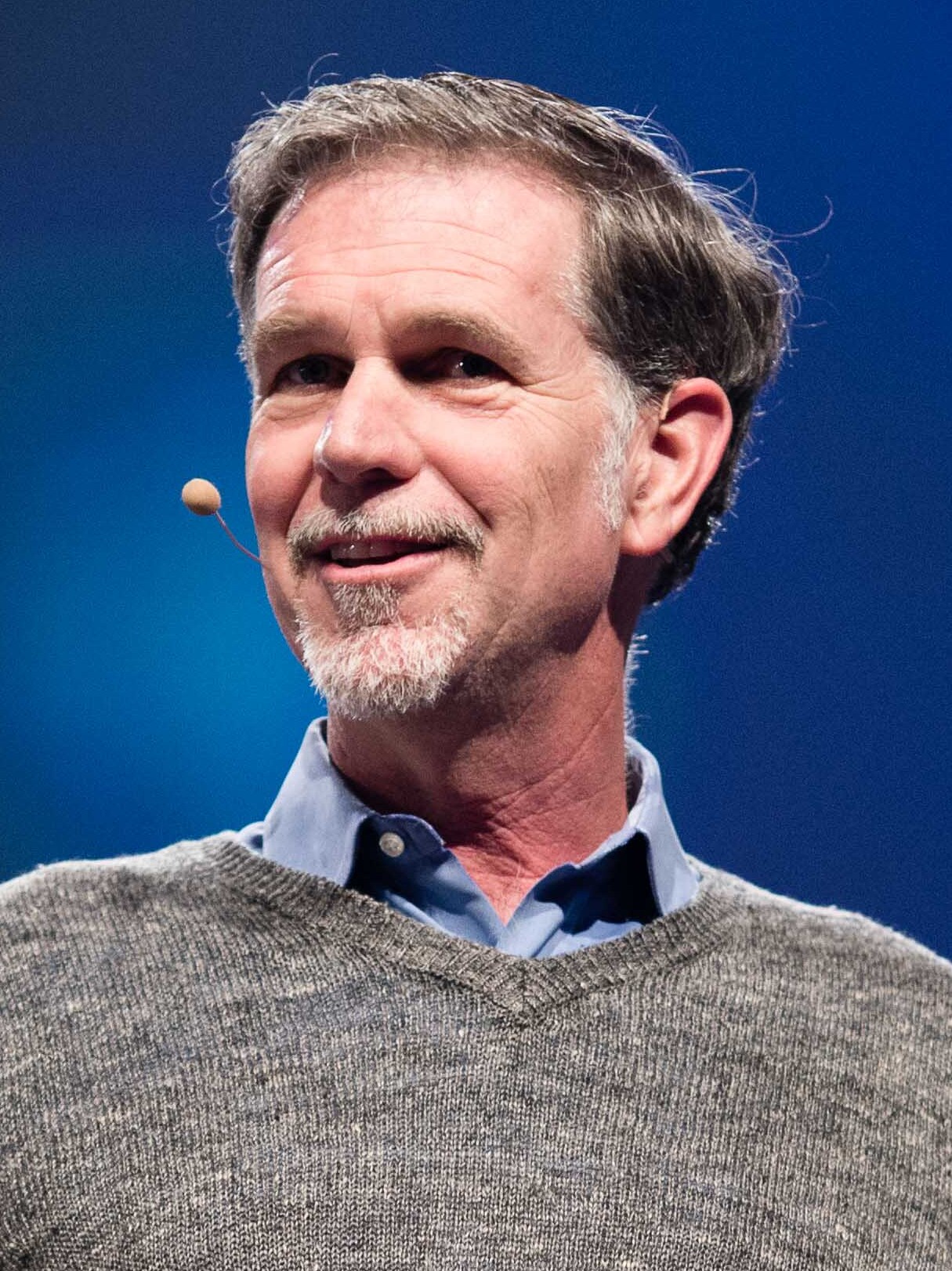
Netflix: Reed Hastings. “We’re Not a Family.” The Provocative Idea That Helped Build a Streaming Giant
Reed Hastings co-founded Netflix in 1997 and led it from a DVD-by-mail service into the world's leading streaming platform, pioneering original content with House of Cards and expanding to over 190 countries. His counterintuitive management philosophy replaced the corporate family metaphor with a championship sports team mindset, favoring radical candor, high talent density, and generous severance for adequate performers. Hastings stepped down as CEO in 2023, passing the reins to Ted Sarandos and Greg Peters, and now chairs the board while pursuing a new challenge: running a Utah ski resort.
Listen on Spotify
Episode Recap
Guy Raz sits down with Reed Hastings to unpack how a math teacher and Peace Corps volunteer built Netflix into a $200 billion entertainment empire — and why his refusal to call employees "family" became the company's most controversial cultural pillar.
From Peace Corps to Pure Software
Hastings' path to Silicon Valley was anything but linear. After studying math at Bowdoin and teaching high school in Swaziland, he earned a computer science degree from Stanford and joined a startup that failed spectacularly. But the lesson stuck: a great product can rescue mediocre management. He applied that insight when he co-founded Pure Software in 1991, learning the hard way that hiring for loyalty over talent cripples performance. The company went public and was acquired for $900 million, giving Hastings his first real exit — and his first management scars.
The Blockbuster Gamble
Netflix launched in 1997 as a DVD-by-mail service, but by 2000 it was on the ropes. Hastings approached Blockbuster with a merger offer: Netflix would become Blockbuster.com. Blockbuster refused, dismissing the upstart as a fly spec. Weeks later, the dot-com bubble burst, and a $50 million investment from LVMH arrived just in time. Hastings credits luck, but also discipline: while competitors burned cash, Netflix conserved and focused on unit economics. The refusal taught him a lesson that would echo for decades — incumbents routinely underestimate disruptive models.
Culture Deck: Team, Not Family
From Pure Software, Hastings carried a painful insight: loyalty-based hiring creates mediocrity. Netflix's Culture Deck declared that adequate performance earns a generous severance package. Hastings framed the company as a championship sports team, not a family — a philosophy that was radical in Silicon Valley and remains controversial today. The deck was meant to attract people who value talent density over job security, but Hastings admits the original version lacked warmth and came across as cold and competitive.
The Quickster Disaster
In 2011, Netflix split its DVD and streaming businesses, spinning off the DVD service as Quickster and raising prices. The reaction was ferocious: customers revolted, the stock dropped two-thirds, and Hastings was forced to apologize in a YouTube video that SNL parodied. The real lesson was organizational silence — executives were too intimidated to push back on Hastings' idea. The fix was the "informed captain" model: top leaders publicly score big decisions on a -10 to +10 scale, making sure dissent appears before a decision is locked in.
Original Content and Global Expansion
Netflix's bet on original content began with Ted Sarandos, who joined in 2000 and commissioned House of Cards in 2010. The show premiered in 2013 to massive success, proving Netflix could compete with HBO. From there, Netflix expanded globally, launching in dozens of countries simultaneously — a direct-to-consumer model traditional networks couldn't match. Hastings stepped back in 2023, handing the CEO role to Sarandos and Greg Peters. His next act is Powder Mountain, a Utah ski resort he bought and is turning into a private real estate community.
Key Takeaways
- 1Build culture around performance, not family: Hastings replaced the corporate family metaphor with a sports team model — high talent density, freedom with responsibility, and generous severance for adequate performers. It is not cold; it is honest clarity.
- 2Surface dissent before decisions are final: After the Quickster disaster, Netflix instituted public scoring on big decisions. Leaders must voice doubts before a choice is locked; once decided, everyone rows together.
- 3Disruptors win by conserving cash while incumbents burn: When Blockbuster dismissed Netflix in 2000, Hastings was already practicing the financial discipline that would outlast dozens of better-funded competitors.
- 4Original content is a moat, not a gamble: House of Cards was not a lucky break — it was the culmination of a strategy Ted Sarandos articulated years earlier. Commissioning prestige programming let Netflix bypass traditional networks entirely.
- 5Global direct-to-consumer beats regional licensing: Netflix was the first streamer to launch in dozens of countries simultaneously. The internet-native distribution model made traditional network licensing obsolete.