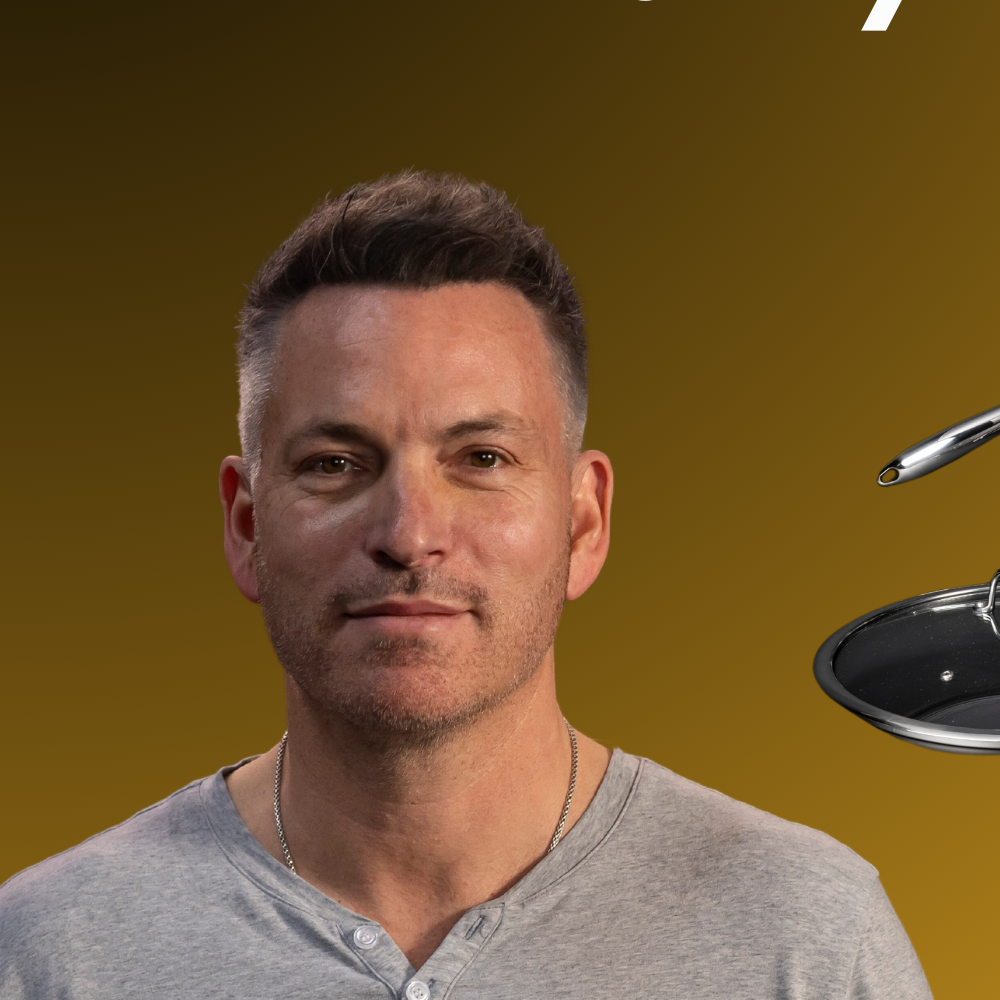
Hexclad: Danny Winer
Guy Raz sits down with Danny Winer, CEO and co-founder of HexClad, to unpack how a late-in-life pivot from a stable marketing career created a half-billion dollar cookware empire. Winer reveals the accidental discovery of hybrid non-stick technology that led him to co-found HexClad with Cole Mecray in 2016, and why securing Gordon Ramsay as an equity partner in 2021 became the brand's defining moment. He shares the operational grit behind scaling a direct-to-consumer kitchen brand while staying true to product-first principles.
Listen on Spotify
Episode Recap
From Marketing Executive to Cookware Founder
Danny Winer did not set out to become a cookware mogul. Before HexClad, he spent more than a decade in marketing, building social media strategies for lifestyle brands. The big shift came when he stumbled upon a new non-stick technology at an overseas trade show and realized the cookware industry was ripe for disruption. With that insight, Winer and his co-founder Cole Mecray launched HexClad in 2016, betting that home cooks wanted the searing power of stainless steel without the frustration of stuck food.
Building a Better Pan
The early days were anything but glamorous. Winer describes cold-calling manufacturers, iterating on prototypes in his garage, and facing skepticism from a cookware market dominated by century-old brands. The breakthrough was HexClad's patented laser-etched hexagonal surface, which bonds a ceramic non-stick coating to stainless steel at a microscopic level. The result is a pan that sears like cast iron, cleans like Teflon, and withstands metal utensils and dishwasher cycles. Rather than chasing retail distribution, Winer went direct-to-consumer, funding growth through customer cash flow instead of venture capital.
The Gordon Ramsay Effect
The brand's trajectory shifted dramatically in 2021 when celebrity chef Gordon Ramsay visited HexClad's Los Angeles headquarters, tested the pans in his own kitchen, and decided to become an equity partner. Ramsay's endorsement validated HexClad's quality claims to a global audience and accelerated expansion into retail partners like Costco. Winer credits the partnership with pushing the team to refine packaging, tighten messaging, and scale manufacturing without compromising the product that made the company famous.
Scaling Without Losing the Plot
Scaling from a garage startup to a half-billion dollar valuation brought new challenges. Winer discusses hiring executives with Fortune 500 experience, building out an omnichannel strategy, and resisting the temptation to dilute the brand with endless product extensions. He also reflects on the pressure of being a founder in the public eye, where every social media post and customer review can swing perception. The episode closes with Winer's perspective on HexClad's future: an IPO on the horizon, international expansion underway, and a focus on keeping the same hybrid pan at the center of the kitchen.
Key Takeaways
- 1Late-Career Pivot: A late-career pivot can unlock billion-dollar potential when founders combine industry experience with genuine consumer insight.
- 2Hybrid Disruption: Hybrid technology that merges competing material strengths can disrupt mature markets dominated by legacy brands.
- 3DTC Advantage: Going direct-to-consumer first preserves margin and customer feedback loops that retail distribution often erodes.
- 4Authentic Endorsement: Strategic celebrity partnerships work best when the endorser is an actual superuser, not just a paid spokesperson.
- 5Quality Over Quantity: Scaling a product-first brand requires resisting the urge to chase every distribution opportunity at the expense of quality.